
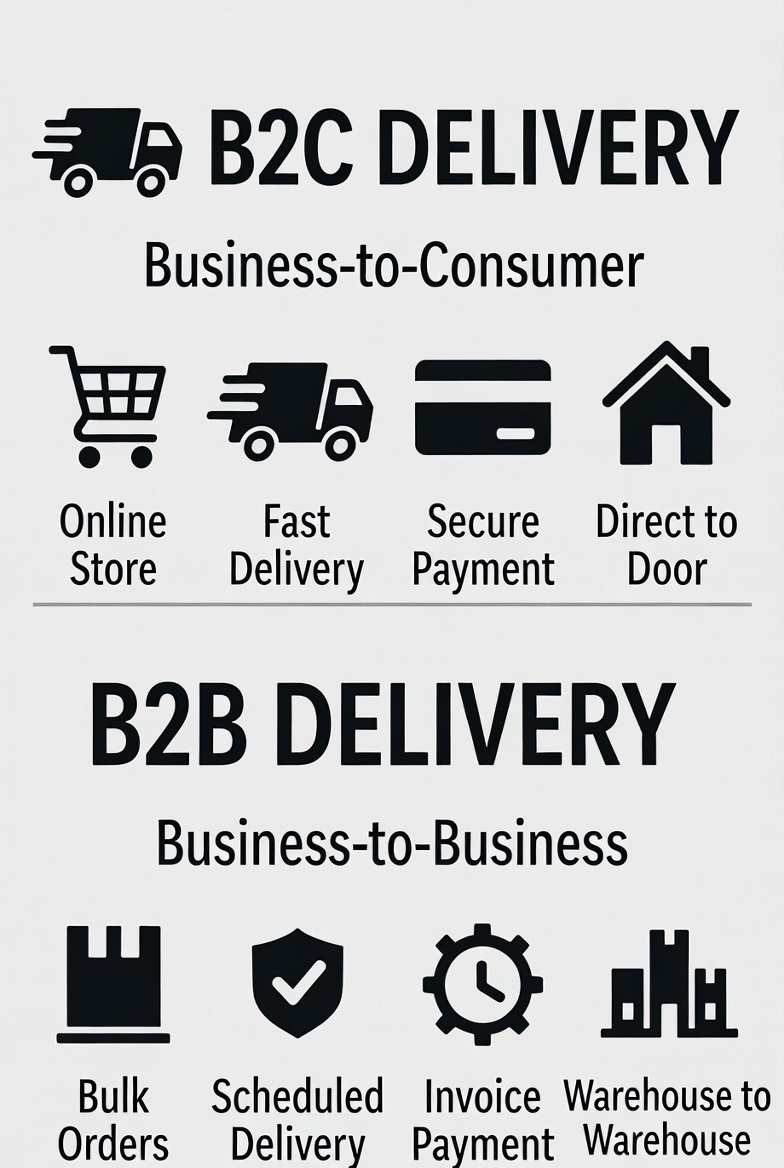
You'll hear these terms thrown around at every depot, in every team meeting, and on every industry article: B2C and B2B. If you're a delivery driver and nobody's ever actually explained what they mean and why they matter to your daily run — here's the breakdown. Because the type of delivery you're doing changes everything: the stop count, the time at each stop, the freight you're handling, and the customer you're dealing with.
What They Mean
B2C — Business to Consumer. This is deliveries from a business to an individual person at a residential address. Online shopping deliveries from Amazon, Temu, The Iconic, Kmart — all B2C. You're delivering to houses, apartments, and front doors. The customer is a regular person waiting for their parcel.
B2B — Business to Business. This is deliveries between businesses. Office supplies to a law firm, parts to a mechanic, stock to a retail store, raw materials to a manufacturer. You're delivering to warehouses, shops, offices, and commercial premises. The customer is usually a receiving dock, a receptionist, or a store manager.
How They Differ for Drivers
Stop Count
B2C runs typically have high stop counts — 100 to 180+ per day. Each stop is quick: one or two small parcels, drop at the door, scan, move on. B2B runs have far fewer stops — sometimes 15 to 40 per day — but each stop takes longer because you're unloading more freight, waiting at docks, and getting signatures. The Australian Border Force import types classifies goods differently depending on whether they're commercial or personal imports, which affects how they're processed through the supply chain before reaching you.
Freight Type
B2C freight is mostly small to medium parcels — satchels, boxes, and mailers. Manageable for one person. B2B freight is heavier and bulkier: pallets, cartons by the dozen, oversize items. You'll need a trolley, a tail lift, and sometimes a forklift operator at the other end. B2B drivers tend to have more physical workloads per stop.
Customer Interaction
B2C customers are unpredictable. They might not be home, they might have a dog, they might have specific ATL instructions. B2B customers are usually consistent — same person at the receiving dock, same process every time. B2B drivers build relationships with their regular business contacts. The downside is B2B customers expect precision: right item, right time, right paperwork.
Timing
B2B deliveries are typically time-sensitive within business hours — you need to deliver before the business closes, and some have strict receiving windows. B2C has more flexibility because residential customers are often ATL, but you're racing the clock on sheer volume. Both have pressure, just different kinds.